
Every South Asian bride faces the same quiet tug-of-war. Part of her wants the classic bridal look from family albums: the centre parting, the gajra-wrapped bun, the tikka sitting perfectly on the forehead. Another part wants the soft waves and textured buns she keeps saving on her phone.
Any experienced hair stylist London brides work with will tell you that you don’t have to choose one side completely. Many of the most beautiful bridal looks blend both.
This guide explains traditional vs modern bridal hairstyling in practical terms: what each style involves, how each one carries heavy jewellery and dupattas, and how to match them to each wedding event.
If you are starting to meet a bridal hair stylist in London, use this guide to walk into your consultation with clear ideas and the right questions.
It also shows why a professional bridal hair stylist matters so much for South Asian weddings. Your hair has to carry jewellery, fabric and tradition, often across several days.
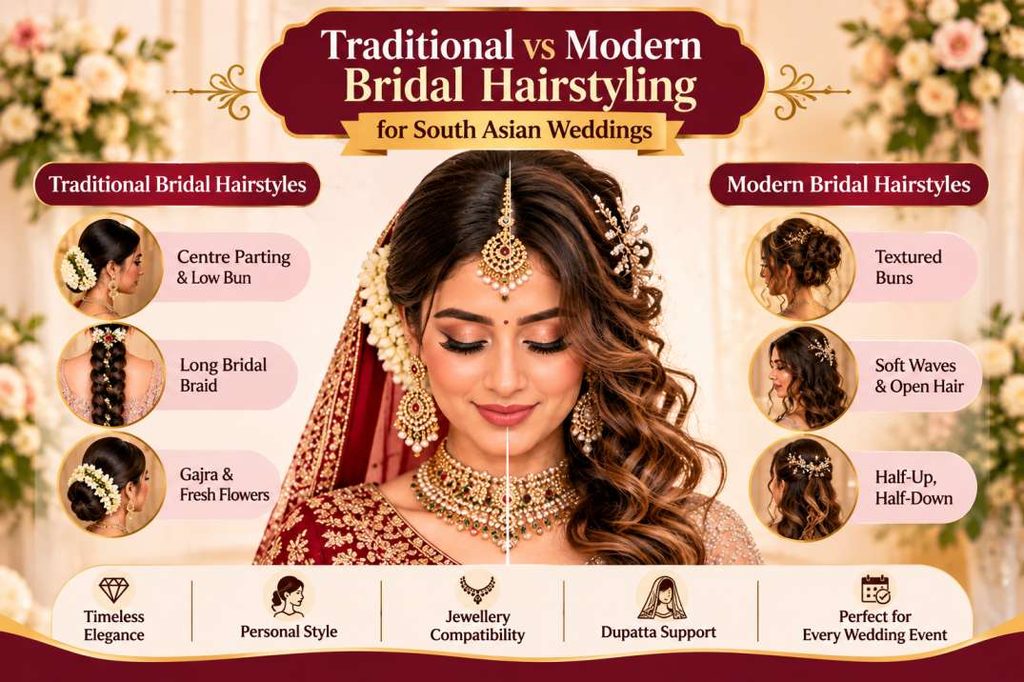
Traditional bridal hair is not one single style. It changes across communities, regions and faiths, and each element often carries meaning.
In traditional looks, the jewellery often decides the hairstyle. A maang tikka needs a smooth parting. A jhoomar or passa, popular with many Pakistani and Muslim brides, sits on one side and needs a firm anchor point. Many Bengali brides wear a mukut with their bun. Each piece changes where the weight sits and how the hair must be built underneath.
Modern bridal hairstyling borrows from fashion and editorial work. It focuses on texture, movement and a softer, more personal finish.
Modern brides usually choose fewer but more striking pieces, such as a fine hair vine, scattered jewelled pins or a single statement flower. Side partings and face-framing strands are popular too, but they need careful planning around a tikka or dupatta.
| Feature | Traditional | Modern |
|---|---|---|
| Parting | Usually centre | Centre, side or softly blended |
| Main shape | Smooth low bun or long braid | Textured bun, waves, half-up |
| Finish | Neat and polished | Soft, textured or sleek |
| Accessories | Gajra, tikka, jhoomar, mukut, bridal pins | Hair vines, statement pins, single flowers |
| Dupatta support | Excellent | Good, with a strong hidden base |
| Hold through long events | Very strong | Strong when well prepared and set |
| Feel | Timeless and ceremonial | Fresh and fashion-led |
Neither style is “better”. The right choice depends on your outfit, your jewellery, your traditions and how you want to feel.
Your natural hair texture affects which styles hold best. This is one of the first things a stylist assesses.
| Hair Type | Traditional Styles | Modern Styles | What the Stylist Usually Adds |
|---|---|---|---|
| Fine or thin | Good with padding | Waves can drop quickly | Texturising spray, hidden padding, more pins |
| Thick or heavy | Excellent; full buns form easily | Waves take longer to set | More sectioning, stronger pins, longer cooling of curls |
| Very straight and silky | Good once grip is added | Curls may slide out | Grip products, curls pinned to cool fully |
| Curly or wavy | Excellent for textured buns | Natural texture can be a bonus | Moisture control, defined curls, frizz management |
| Layered or shoulder length | Bun may need extensions | Half-up and waves suit well | Clip-in extensions matched to colour |
If your hair is fine and you love a full traditional bun, clip-in extensions or padding can help. Bring them to your trial so they can be blended and tested.
Heavy pieces need the right foundation. Here is how stylists typically plan for them.
| Piece | Where the Weight Sits | How the Hair Is Built to Hold It |
|---|---|---|
| Maang tikka | Centre front | Smooth centre parting with a small secured section at the crown |
| Jhoomar or passa | One side of the head | Firm anchor braid or pinned section on that side |
| Mukut or crown | Top of the head | Strong base at the crown and pins crossed through it |
| Gajra | Around the bun or braid | Tight, well-shaped bun or braid to wrap and pin into |
| Heavy dupatta | Top and back of the head | Anchor point behind the bun, so the dupatta pins into structure, not loose hair |
Always bring every piece to your trial. A style that feels light on its own can feel very different once a jhoomar and a heavily embroidered dupatta are added.
| Event | Typical Direction | Why It Works |
|---|---|---|
| Mehndi or haldi | Modern or playful traditional | Braids with paranda, flowers or loose texture suit the relaxed mood |
| Nikah, pheras or main ceremony | Traditional or traditional-led hybrid | Secure buns hold heavy dupattas and jewellery through long rituals |
| Walima or reception | Modern | Waves, sleek buns or half-up styles match lighter outfits |
Picture a bride with three events. For her mehndi, she wears a loose side braid woven with fresh flowers. For her main ceremony, she chooses a classic low bun with a centre parting, a tikka and a jhoomar under a heavy dupatta. For her reception, she switches to soft waves with a single jewelled pin. Each look feels different, but together they tell one story.
Many brides land on a hybrid. It keeps a traditional foundation, such as a secure low bun and centre parting, but adds modern texture, softer front sections or a fresher floral arrangement.
This is where a professional bridal hair stylist earns their place. The hidden base must be strong enough to carry jewellery and fabric, while the visible finish must look soft and effortless. Get the balance wrong, and the style either looks stiff or loosens before the ceremony ends.
A heavily embroidered dupatta pulls on the hair all day. A skilled bridal hairstylist builds a firm anchor behind the bun, so the dupatta pins into the structure. This keeps it in place through rituals, hugs and photos, and stops the hairstyle being dragged backwards.
For brides who wear a hijab, the hair underneath still matters. A smooth, low bun or a flat base gives the hijab a neat shape without bulk. Traditional and modern touches then come through the hijab style, the dupatta setting and jewellery such as a jhoomar.
Several days of styling, heat and pinning can stress your hair. Repeated tight styles that pull on the same area can damage the hairline over time, so comfort matters as much as hold.
A trial is where you test both directions before committing. During a bridal hair trial London brides attend, a careful stylist checks more than looks.
| Test | Why It Matters |
|---|---|
| Head movement check | Shows whether pins and the base stay secure when you turn and nod |
| Dupatta pull test | Confirms the dupatta is pinned into structure, not loose hair |
| Jewellery balance | Ensures the tikka and jhoomar sit straight and comfortably |
| Comfort check | Identifies pressure points before you wear the style for hours |
| Camera check | Shows how the style photographs from the front, side and back |
A bridal hair stylist in London will also suggest wearing the trial style for the rest of the day. Notice where it loosens, feels heavy or starts to ache, and share that feedback.
Share your full outfit plan early. Photos of each outfit, jewellery set and dupatta help any hair stylist London brides rely on plan the right structure.
Ask about your traditions directly. A hair stylist for asian weddings London brides recommend should either know your community’s customs or ask thoughtful questions about them.
Ask to see late-day photos. Fresh morning photos show styling skill. Photos taken during the evening show how well the style holds.
Booking a hair and makeup stylist London brides trust keeps the whole look balanced, because hair, makeup and jewellery are planned together and the morning involves fewer people.
A mobile hair stylist London brides book travels to your home or venue, which keeps busy wedding mornings calm. Studio sessions suit trials, thanks to controlled lighting.
Searching for a “hair stylist near me” is a sensible first step. Before booking, look for unfiltered bridal work, especially traditional styles worn under heavy dupattas.
The traditional vs modern bridal hairstyling decision doesn’t need one fixed answer. The most memorable looks often blend heritage and personal style, event by event.
An experienced hair stylist London brides trust will help you find that balance while keeping your hair secure, comfortable and healthy.
Test both directions with a bridal hair stylist in London at your trial, using your real jewellery and dupatta.
If you would like a professional bridal hair stylist who plans around South Asian traditions, Ummi Chowdhury Mua would love to hear about your wedding. Book a consultation, bring your outfit photos and jewellery, and let us design bridal hair for every event.
The main difference in traditional vs modern bridal hairstyling is the overall feel and structure. Traditional styles usually feature a centre parting, a smooth low bun or long braid, fresh flowers and classic jewellery such as a tikka or jhoomar. Modern styles focus on texture, waves, side partings and fewer accessories. Many brides choose a hybrid, using a traditional base for strength and modern softness for a fresher finish.
A secure low bun usually works best under a heavy dupatta, because it sits close to the head and gives the stylist a strong anchor point to pin into. Traditional buns are especially reliable, but modern textured buns also work when built on a firm hidden base. Avoid fully open hair under heavy dupattas, because the fabric flattens waves and pulls the style backwards as the day goes on.
Styling across several events won’t damage your hair if it is done carefully. Problems usually come from styles that pull tightly on the same area, rough take-downs and too much extra heat. Ask for styles that feel secure but not tight, remove every pin before loosening your hair and rest your hair between events. If any style aches or pulls, tell your stylist so they can adjust it straight away.
Look for a bridal hair stylist in London with real experience of South Asian weddings, heavy jewellery and dupattas. Ask for unfiltered photos of traditional and modern styles, ideally taken late in the day. Check that they offer a proper trial with hold and comfort checks, and that they understand your family’s traditions. Clear communication matters too, because your stylist should listen to your family’s expectations as well as your own.
A professional bridal hair stylist plans each event’s look as part of a complete story. They build secure foundations for heavy ornaments, switch smoothly between traditional and modern styles, and protect your hair from repeated stress across several days. They also know how hair texture, extensions and dupatta weight affect hold. This planning keeps your hair comfortable, healthy and beautiful from the mehndi to the reception.
Please complete the form below, to request a quote, and we’ll be in touch. Or you can call us 07534 814316 and our specialists will provide the necessary help!
Ummi Chowdhury MUA is a professionally trained freelancer specialising in hair and makeup services for grand events and parties. An authorised makeup artist with combined experience, Ummi is all set to establish the perfect dazzling look as per your desire.


